A new study finds the average chimpanzee response time in gestured conversations is 120 milliseconds, which isn’t that far from the human average of 200 milliseconds.
Introduction
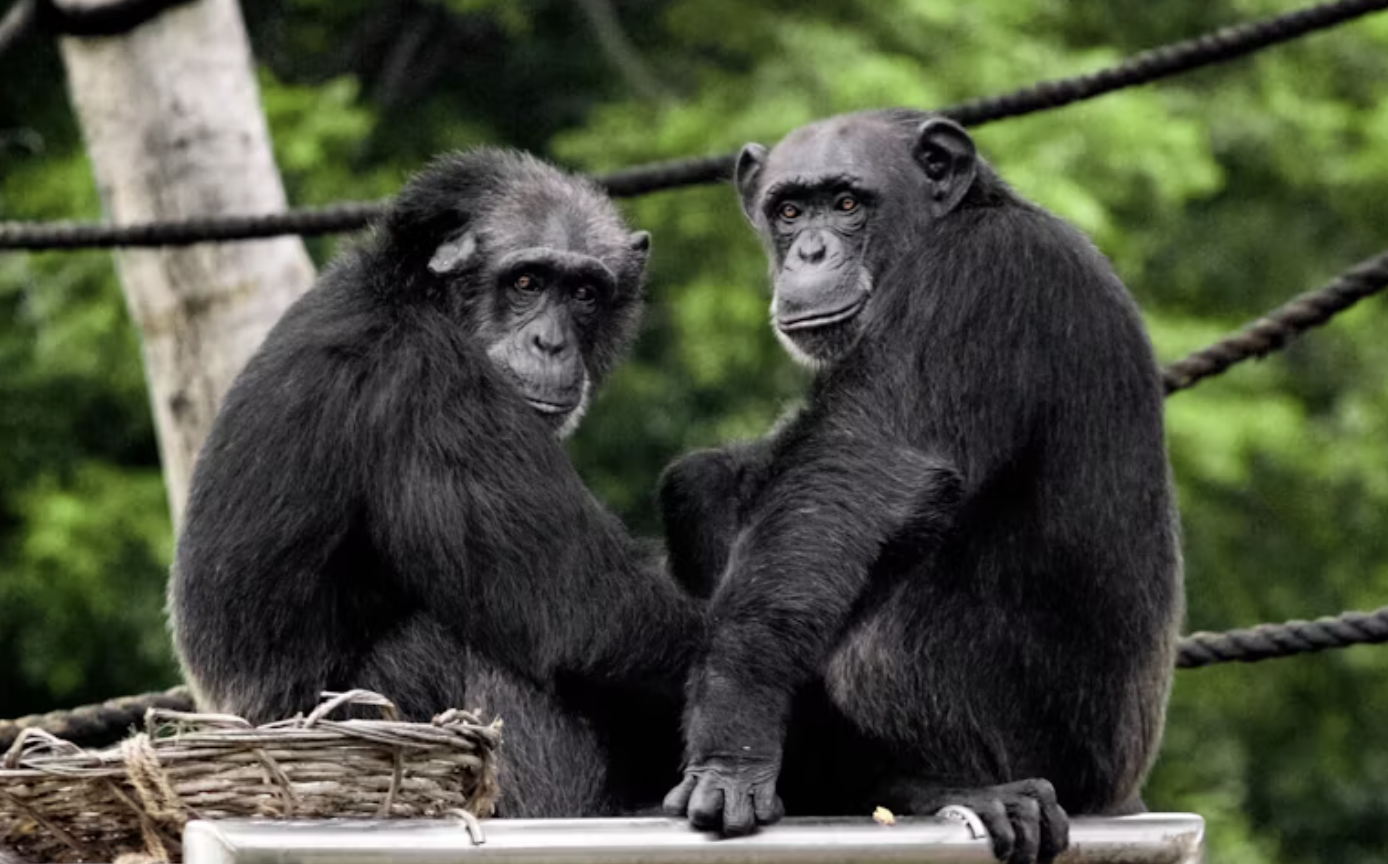
When humans have conversations, we take turns speaking, sometimes even interrupting each other. Now, a study published in Current Biology on Monday reports that chimpanzees follow a similar communication pattern structured around back-and-forth, fast-paced turns—albeit with gestures rather than speaking.
“Human conversation follows very strict rules of turn-taking that are consistent across cultures and languages,” Gal Badihi, an animal behavior researcher at the University of St Andrews in Scotland and first author of the study, tells the Guardian’s Tanya Procyshyn. “We started to wonder whether chimpanzee communication was governed by its own rules, or if the rules are similar to human conversation.”
Chimpanzee Gestures
Chimpanzee gestures are largely meant to convey requests, with “groom me,” “follow me,” “give me” or “stop it” being common commands. The researchers witnessed a variety of gestured interactions, such as chimps asking to change spots during grooming sessions. Once, a chimp named Ursus gave a reassuring tap to a chimp named Monica when she reached her hand out after a quarrel. In another instance, a male chimp repeatedly made “go away” gestures as a female asked for some meat from an antelope he had killed.
The Study
To explore patterns in this communication, the team of scientists collected footage of 8,559 gestures from 252 individuals in five chimp communities in eastern Africa, assembling the largest dataset of chimpanzee conversations ever made. They found that 14 percent of the recorded interactions included at least one response to a gesture, while some included as many as seven back-and-forth responses.
Then, the researchers timed the turns within conversations—in other words, they measured how long it took chimps to respond to each other. Chimps took an average of 120 milliseconds to reply with a gesture, which is not all that dissimilar from the human average of 200 milliseconds.
Significance of the Findings of Chimpanzee
The discovery of this quick-paced turn-taking is significant because it indicates that chimpanzees communicate with intention and meaning, just like humans do, Mélissa Berthet, an animal communication researcher at the University of Zurich in Switzerland who was not involved in the study, tells Science’s Cathleen O’Grady. This is different from other animals like dogs, for example, because an exchange of barking could just be a reflex, rather than a true response in a conversation.
Another similarity scientists noticed is the slight difference in response time between chimp communities—a variation that also exists among different human cultures.
“Fascinatingly, they seem to share both our universal timing and subtle cultural differences,” senior author Cat Hobaiter, an expert in primate communication at the University of St Andrews, says in a statement. “In humans, it is the Danish who are ‘slower’ responders, and in Eastern chimpanzees that’s the Sonso community in Uganda.”
Evolutionary Implications
The parallels also suggest “deep evolutionary similarities [with humans] in how face-to-face conversations are structured,” Hobaiter tells BBC News’ Victoria Gill. This means that either a common human-chimp ancestor developed this conversation pattern before we split apart on the evolutionary tree, or that humans and chimpanzees developed the same conversation pattern independently. Alternatively, this rapid turn-taking may be a common evolutionary feature of social communication that researchers just haven’t noticed in other species yet.
“To get at that question, we need to explore communication in more distantly related species,” Hobaiter says in the statement, “so that we can work out if these are an ape characteristic or ones that we share with other highly social species, such as elephants or ravens.”
Conclusion
This study sheds light on the sophisticated communication methods of chimpanzees, highlighting the similarities between their gestured conversations and human verbal interactions. These findings not only deepen our understanding of chimpanzee behavior but also offer insights into the evolutionary roots of human communication. As research continues, we may discover that this rapid, intentional turn-taking is more widespread across species than previously thought, further bridging the gap between human and animal communication.
At AHB Lab, we draw inspiration from these scientific breakthroughs to fuel our own research and development. Our commitment to excellence and innovation in peptide manufacturing is unwavering, and we strive to report the latest news in science and biotechnology to keep you informed and inspired. Join us on our quest as we forge new paths in science, contributing to the future of biotechnology with our groundbreaking research and unwavering dedication.